
Founders rarely come to us asking for better spreadsheets or more detailed reports. They come because something feels out of sync. Revenue might be growing, the business looks healthy on paper, yet decisions feel harder than they should. Cash feels tighter than expected. Conversations about hiring, investment or spend are clouded by uncertainty. When a founder says they need better financial control, what they are really asking for is confidence.
This moment usually arrives after progress, not before it. The business has moved beyond its early simplicity and the numbers have become more complex. What once felt intuitive now requires structure. Control, in this context, is not about limiting ambition or slowing things down. It is about understanding where the business truly stands and why. Without that understanding, even strong performance can feel fragile.
In our experience, financial control has very little to do with rigid processes or heavy reporting. It is about having a clear, shared view of where you are, where you want to be and what needs to happen in between. When that clarity exists, decisions become easier, trade offs are more deliberate and the business moves forward with intent rather than guesswork.
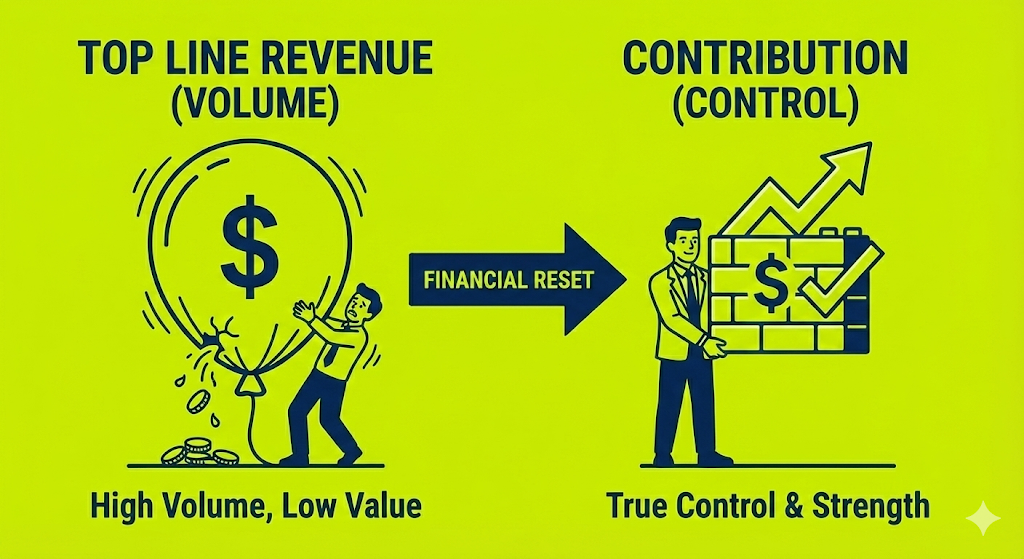
One of the first things we look at is how revenue is actually contributing to the business. Founders are right to focus on growth. Revenue is the lifeblood of any company. The problem arises when that focus stops at the top line. Not all revenue is equal, and growth on its own does not guarantee control.
We often see businesses with strong sales numbers but very thin contribution margins on certain products or services. These revenue lines add volume but little value. Over time, they absorb time, attention and resources while delivering limited flexibility. Without a clear view of contribution margin, founders can unknowingly scale parts of the business that make everything else harder.
A financial reset brings this into focus. By understanding which revenue streams truly support the business and which quietly erode it, founders gain a far more accurate picture of performance. Control, in this sense, is knowing not just how much you are selling, but how each sale strengthens or weakens the foundations of the business.
After revenue, attention usually turns to costs. On the surface, expenses can appear under control simply because nothing feels obviously out of place. In reality, many businesses accumulate layers of spending that go largely unquestioned. Tools and subscriptions are added as the company grows, marketing budgets expand and initiatives continue long after their impact has faded.
What we often find is not reckless spending, but unexamined spending. Founders are busy building the business and rarely have the time to step back and ask whether each cost still earns its place. Over time, small decisions compound. Money is tied up in software that is rarely used or marketing activity that no longer delivers a clear return. Individually, these costs feel manageable. Collectively, they reduce flexibility and increase pressure.
A proper review of expenses is not about cutting for the sake of it. It is about understanding what actually drives value. When founders reconnect costs to outcomes, decisions become clearer. Spending becomes intentional rather than habitual, and control shifts from monitoring totals to actively shaping how resources are used.
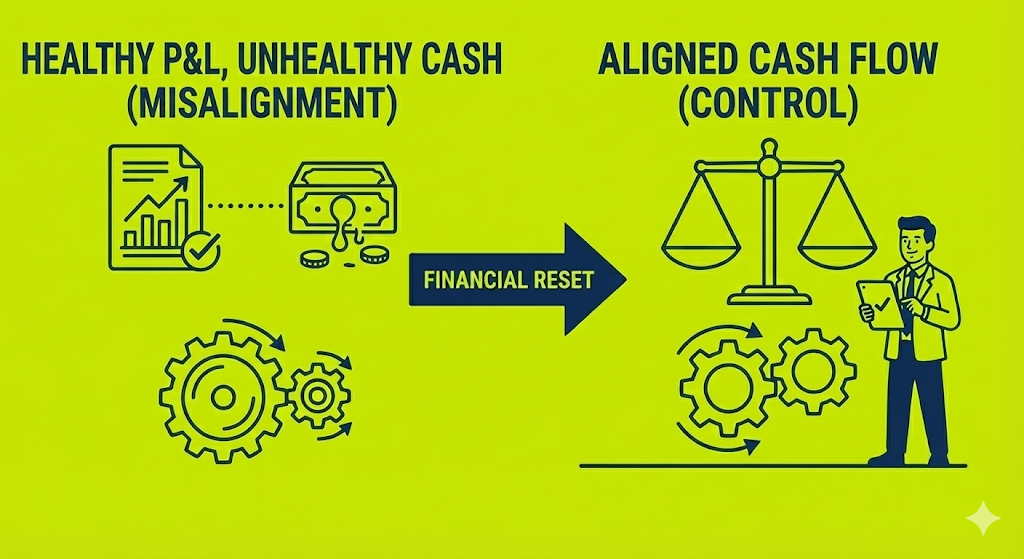
One of the most common situations we see is a business that appears healthy on the P&L, yet feels constantly short on cash. From the outside, the numbers look solid. Revenue is growing, margins seem acceptable and there are no obvious warning signs. From the founder’s perspective, however, there is a persistent sense of pressure. Decisions are delayed, buffers feel thin and confidence begins to erode.
When we dig deeper, the pattern is usually clear. Cash is tied up in the day to day mechanics of the business. Clients take longer to pay than expected, while suppliers are paid quickly and predictably. The business is effectively funding its customers, even though performance on paper suggests everything is under control. This imbalance often goes unnoticed until it becomes uncomfortable.
By looking closely at the cash conversion cycle, accounts receivable and payables, we can surface these issues early. For many founders, this is a turning point. They realise that financial control is not about improving profit in isolation, but about aligning cash timing with how the business actually operates. Once that alignment exists, pressure eases and decisions feel grounded again.
Many founders come into a new year with a clear sense of where they want the business to go. Revenue targets are set, growth ambitions are defined and there is no shortage of ideas. What is often missing is a structured path between today and those goals. Without that structure, targets remain aspirations rather than plans.
This is where the budgeting process becomes transformative. When we build an annual budget with a founder, usually in Q4 for the year ahead, the conversation shifts. Ambition is translated into timing, sequencing and trade offs. We break goals down into the deals that need to be closed, the hires that must be made, the costs that need to be reduced and the moments where pressure is likely to arise.
Founders often leave these sessions with a sense of relief. Their ideas have not been constrained, they have been given shape. The budget becomes a roadmap rather than a restriction. It provides a clear game plan for how to act month by month, turning financial control into something practical and actionable rather than theoretical.
As businesses grow, the limits of financial data alone become more apparent. Revenue and costs tell part of the story, but they do not explain how efficiently the business is operating. To understand that, operating KPIs are essential. This is often where we encounter the most resistance, particularly when it comes to tracking time spent on projects or clients.
Founders and teams frequently worry that time tracking will create tension or feel like micromanagement. That concern is understandable. Used poorly, it can damage trust. Used well, it does the opposite. When positioned correctly, time tracking is not about monitoring individuals, but about understanding capacity. It answers fundamental questions about where effort is going and whether the business is structured to scale.
We have consistently seen that when founders communicate this purpose clearly, the resistance fades. The insights gained from these metrics are powerful. They reveal which work is profitable, where teams are stretched and what needs to change before growth accelerates. Without this visibility, scaling becomes guesswork. With it, founders gain the confidence to make informed decisions about pricing, resourcing and growth.
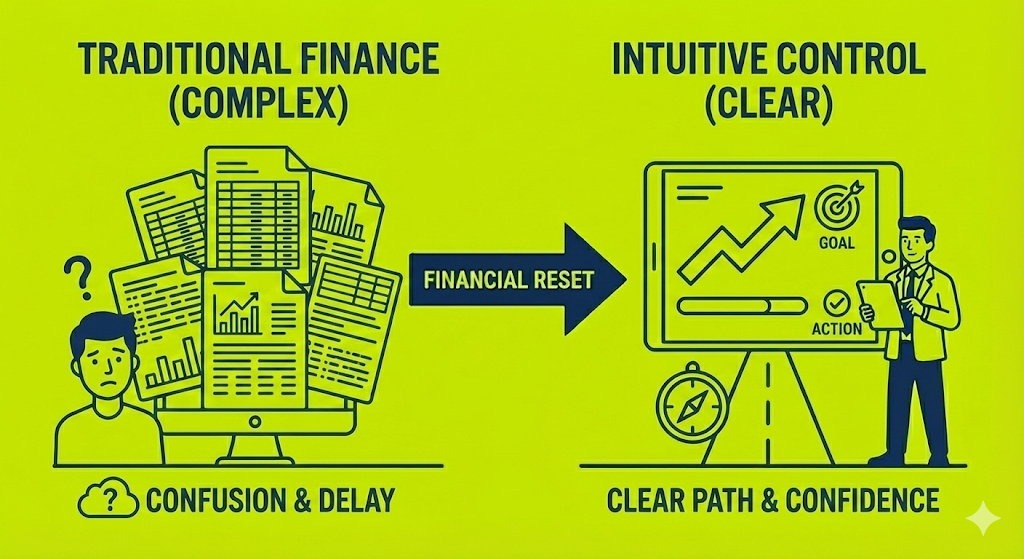
By the time these pieces are in place, something important shifts. Financial control stops feeling like a technical exercise and starts to feel intuitive. Founders no longer need to dig through reports to answer everyday questions. They have a clear, often visual snapshot of where the business stands, where it is heading and what needs to happen next.
For us, this is what financial control really means. It is the ability to quickly understand the gap between today and your goals and to see the actions required to close it. The spreadsheets, systems and reports still exist, but they sit in the background. They support the picture rather than define it.
When control is framed this way, finance becomes a practical leadership tool. Founders can make decisions with confidence because the answers they need are accessible and grounded in reality. Instead of reacting to numbers after the fact, they lead with clarity, using finance as a guide rather than a constraint.
Financial control is not about tighter processes or more complex reporting. It is about understanding how the business truly works and having the confidence to act on that understanding. When founders gain clarity on contribution, cash, capacity and the drivers behind their numbers, finance stops being a source of tension. It becomes a support for better decisions and more intentional growth.
The businesses that feel most in control are not those with the most detailed spreadsheets, but those with the clearest view of reality. They know where pressure is building, where value is created and what trade offs lie ahead. That clarity allows them to move forward decisively, even when conditions are uncertain.
If you want financial control that gives you answers, not just reports, we would love to help. At Quantro, we work with founders to turn numbers into insight and plans into action. Book a conversation with our team to explore how greater clarity can support more confident decisions in your business.
More from Quantro
Innovative cash flow management strategies are crucial for any business's survival and growth. In this blog, we cover optimising payment cycles, using financial tools for passive income, leveraging technology for real-time insights, and building a cash-savvy culture. The article provides practical advice, aiming to transform routine financial management into a strategic asset that enhances operational efficiency and financial stability, equipping businesses to navigate complex economic landscapes effectively.
Read More →Explore the complexities of scaling operations in service businesses. We look into recognising the right time to scale, addressing operational challenges, leveraging technology efficiently, maintaining exceptional customer experience, and managing team dynamics effectively. We use practical examples of how to use key performance indicators to navigate growth and ensure that your business not only expands in size but also enhances its capabilities and maintains its core values. Perfect for business leaders seeking to understand the nuances of sustainable growth in the service sector.
Read More →