
The start of a new year often brings a surge of energy. Founders return from the break ready to set targets, finalise budgets and push the business forward. January feels like the moment to move fast. Yet this urgency can be misleading. When financial decisions are made too quickly, they are often built on momentum rather than understanding. The result is a plan that looks confident on paper, but is fragile beneath the surface.
A financial reset is not about slowing the business down. It is about creating the clarity needed to move with intent. Too often, finance at the start of the year becomes a tidy up exercise. Last year’s numbers are reviewed, new goals are agreed and attention shifts immediately to execution. What is missing is the pause to ask what those numbers actually mean and what they imply for the year ahead.
When done properly, a financial reset creates a different kind of confidence. Not the optimism that comes from ambitious targets, but the assurance that decisions are grounded in reality. It gives founders a clear view of their constraints, their options and the trade offs they are likely to face in 2026. From that place of clarity, progress becomes more deliberate and far more sustainable.
At the beginning of the year, activity often replaces insight. Financial reviews are completed quickly, management meetings focus on targets and the conversation moves rapidly towards growth. On the surface, this looks like good leadership. In reality, many of these discussions are built on assumptions that have not been properly tested. Numbers are accepted as facts, even when no one has taken the time to understand what truly drove them.
Looking back at last year’s performance is rarely enough on its own. Revenue growth might hide margin pressure. Strong results in one quarter may have been driven by one off factors that will not repeat. Costs that crept in gradually can become fixed before anyone notices. Without digging into these details, founders risk carrying last year’s blind spots straight into the new plan.
A proper financial reset challenges this pattern. It shifts the focus from what happened to why it happened. That change in perspective is critical. When founders understand the forces behind their numbers, they stop reacting to outcomes and start shaping them. Only then does momentum become something that supports better decisions, rather than something that quietly undermines them.
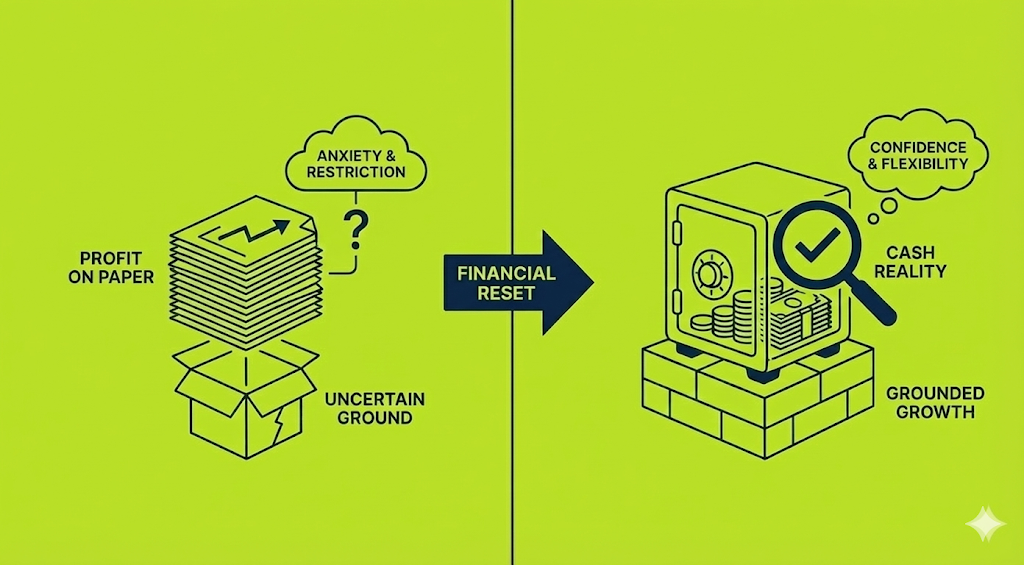
The most important part of a financial reset is often the one founders are keenest to move past. Cash. It is tempting to focus on revenue, growth rates or profitability, yet none of these tell you how much room you truly have to manoeuvre. Cash does. Without a clear view of cash, even the most ambitious plans rest on uncertain ground.
Many businesses confuse reported performance with decision making reality. Profit on paper can exist alongside rising pressure on cash. Timing differences, working capital swings and investment commitments all shape what is actually available to the business. A reset forces these dynamics into the open. It answers simple but essential questions about runway, pressure points and how much flexibility really exists.
What surprises many founders is that this clarity rarely feels restrictive. In fact, it often has the opposite effect. When cash is properly understood, decisions become calmer and more confident. Trade offs are clearer, priorities sharpen and growth conversations become more grounded. Cash stops being a source of anxiety and becomes a reference point for leadership.
Once cash reality is clear, the next step in a financial reset is understanding the story behind the results. Financial statements show what happened, but they rarely explain why. Revenue, margin and cost lines are outcomes, not causes. Without unpacking the drivers behind them, it is easy to draw the wrong conclusions about performance.
This is where many planning conversations fall short. A strong year can mask underlying weaknesses, while a difficult period may hide progress that has not yet translated into results. Growth might have come from a single large client, a short term pricing decision or an unusually strong marketing channel. Costs may have increased in ways that are not obvious from a headline P&L. Until these factors are clearly identified, last year’s numbers remain open to misinterpretation.
Rebuilding the narrative behind the numbers changes how founders approach the year ahead. It allows them to separate what was repeatable from what was circumstantial. That distinction is critical. It prevents overconfidence where caution is needed and avoids unnecessary restraint where momentum is real. A financial reset is not about judging past performance, but about understanding it well enough to plan forward with clarity.
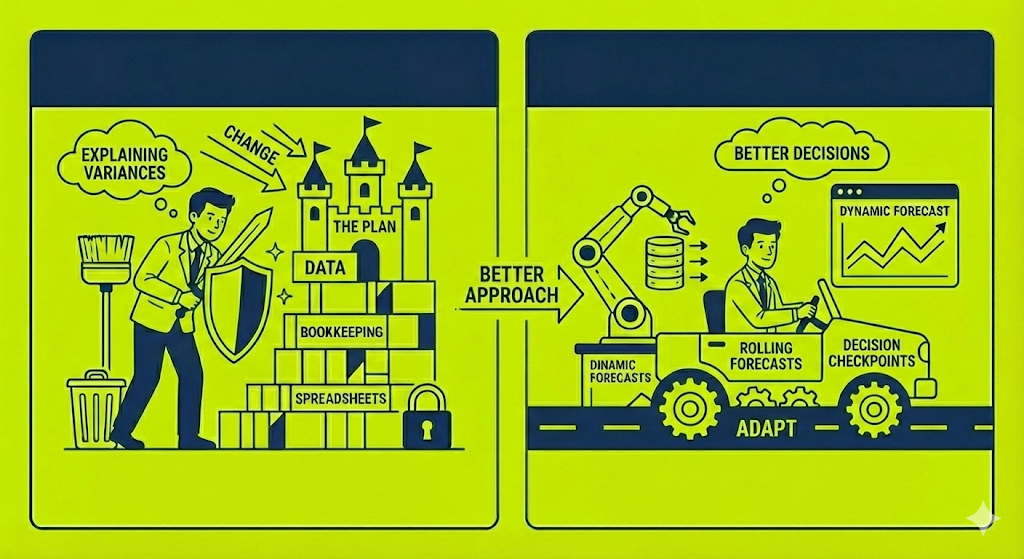
Many financial plans fail not because they are wrong, but because they are too rigid. At the start of the year, assumptions are locked in, budgets are approved and the plan becomes something to protect rather than revisit. As conditions change, teams spend more time explaining variances than making decisions. The plan turns into a reference point for accountability, not a tool for leadership.
This rigidity creates a quiet tension. Everyone knows the numbers no longer reflect reality, yet changing them feels like an admission of failure. As a result, decisions are made outside the plan, while the plan itself becomes less relevant with each passing month. What began as a source of clarity slowly loses credibility.
A better approach is to design plans that expect change. This does not mean abandoning discipline or lowering standards. It means building flexibility into the process from the start. Rolling forecasts, clear decision checkpoints and explicit assumptions allow leaders to adapt without losing control. When a plan is designed to evolve, it supports better decisions throughout the year, rather than becoming something that needs to be defended.
A financial reset only creates value if it changes how decisions are made day to day. Too often, planning work is completed in January and slowly fades into the background as the year unfolds. The numbers exist, but they are not actively used to guide choices. A reset should do the opposite. It should shape how priorities are set, how risks are assessed and how trade offs are discussed throughout 2026.
This is where forecasting and regular checkpoints become essential. Rather than revisiting the plan once a year, leaders review it frequently, testing assumptions against reality. When performance shifts, the conversation focuses on what has changed and what decisions follow, not on who missed a target. Finance becomes a forward looking tool that informs action, rather than a backward looking scorecard.
When used this way, the financial framework supports better leadership conversations. Hiring, investment and growth decisions are evaluated against cash impact and strategic intent, not just ambition. Over time, this builds confidence across the business. Teams understand how decisions are made and why. The reset stops being an event at the start of the year and becomes a discipline that guides the business through it.
When a financial reset is done well, the impact shows up quickly in how decisions are made. Founders spend less time reacting and more time choosing deliberately. Conversations move faster because the underlying assumptions are clear. Instead of debating the numbers themselves, teams focus on the implications and the actions that follow.
One of the biggest shifts is a reduction in surprises. This does not mean everything goes to plan, but that deviations are spotted earlier and understood more clearly. Cash pressure, margin changes or slower growth are identified before they become problems. This gives leadership the space to respond thoughtfully rather than under pressure, which often leads to better outcomes.
Perhaps most importantly, alignment improves. Leadership teams, boards and investors gain a shared understanding of where the business stands and why decisions are being made. Finance becomes a source of confidence rather than friction. Over time, this trust compounds, making it easier to navigate uncertainty and keep the business moving in the right direction.
A financial reset is not about starting again or lowering ambition. It is about creating the clarity needed to lead with confidence. When founders take the time to understand their cash position, the drivers behind their numbers and the assumptions built into their plans, finance stops being something that happens in the background. It becomes an active part of how decisions are made throughout the year.
The businesses that navigate uncertainty best are not those with the most detailed plans, but those with the clearest understanding of their reality. A good reset provides that understanding. It replaces false certainty with informed judgement and gives leaders the confidence to act, even when the future cannot be predicted with precision.
If you are ready to approach 2026 with greater clarity, control and confidence, we would love to help. Book a meeting with our team to explore how Quantro can support your financial reset and build a planning framework tailored to your business. One that gives you not just numbers, but the insight needed to lead decisively through the year ahead.
More from Quantro
Innovative cash flow management strategies are crucial for any business's survival and growth. In this blog, we cover optimising payment cycles, using financial tools for passive income, leveraging technology for real-time insights, and building a cash-savvy culture. The article provides practical advice, aiming to transform routine financial management into a strategic asset that enhances operational efficiency and financial stability, equipping businesses to navigate complex economic landscapes effectively.
Read More →Explore the complexities of scaling operations in service businesses. We look into recognising the right time to scale, addressing operational challenges, leveraging technology efficiently, maintaining exceptional customer experience, and managing team dynamics effectively. We use practical examples of how to use key performance indicators to navigate growth and ensure that your business not only expands in size but also enhances its capabilities and maintains its core values. Perfect for business leaders seeking to understand the nuances of sustainable growth in the service sector.
Read More →