
Preparing a business for an exit is often seen as something that happens at the end. A founder decides it is time to sell, the data room is opened, and the scramble begins. In reality, exit readiness starts long before the first conversation with a potential buyer. The foundation for a successful sale is built quietly in the background through clean reporting, consistent processes and a financial narrative that investors can trust. When these disciplines are in place, everything from valuation to deal speed improves. When they are not, even strong businesses struggle to convince buyers that their success can be repeated.
Investor ready reporting is not simply a higher standard of accounting, it is a different way of running a business. It requires clarity in how value is created, transparency in how performance is measured and a commitment to showing the underlying economics of the company long before due diligence begins. Done well, this preparation does more than support an exit. It strengthens leadership decisions, improves operational discipline and creates a business that is easier to run and easier to buy. Exit readiness is ultimately about confidence. Buyers need to believe the future cash flows are stable and predictable, and leadership needs to believe they can explain them with clarity.
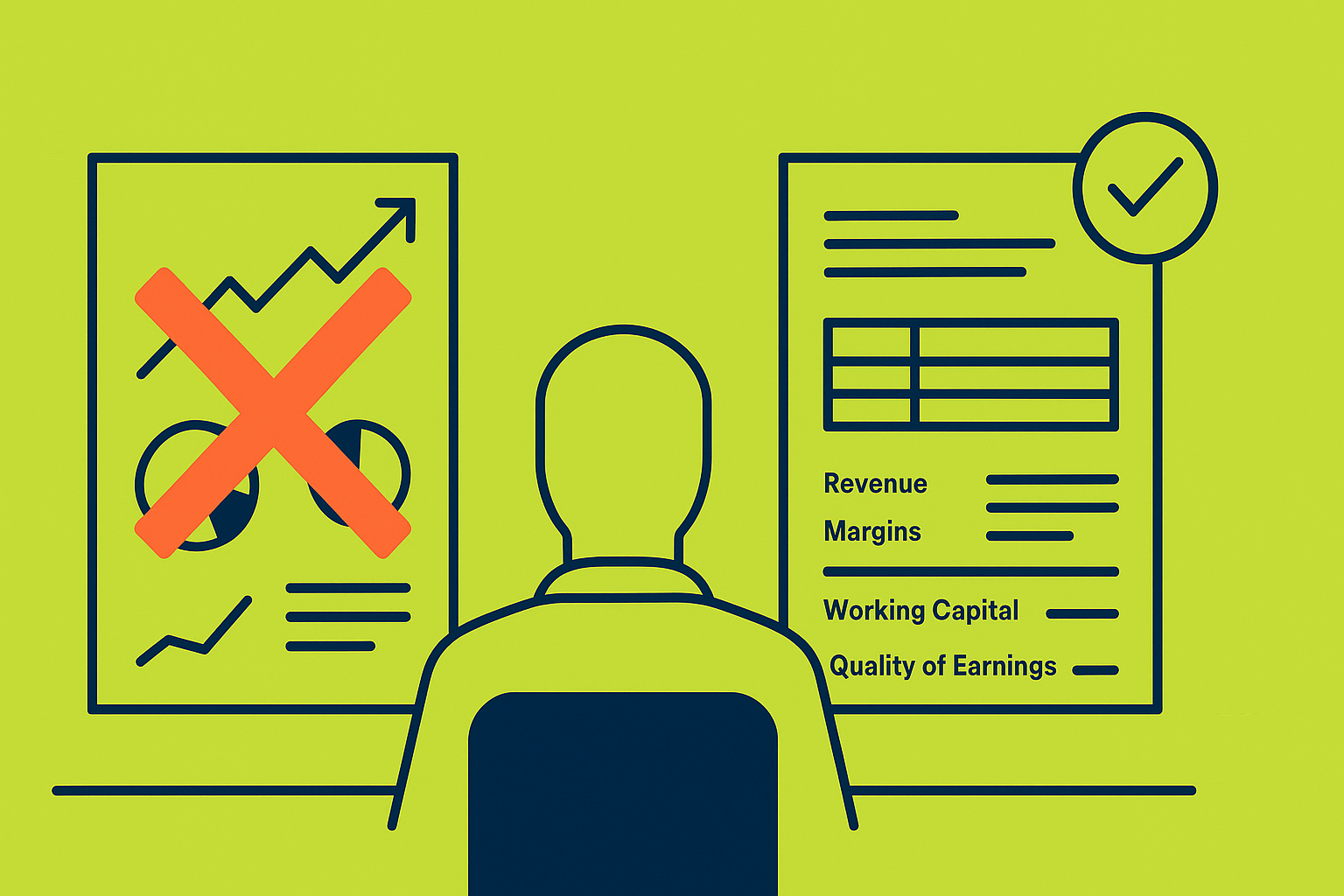
Most founders believe investors care primarily about growth. They highlight top line performance, market opportunity and the potential of the product. But when buyers begin their assessment, they look for something very different. They want evidence that the numbers are real, repeatable and supported by a financial system that can withstand scrutiny. Investor ready reporting is not about presenting impressive figures, it is about demonstrating control. Clean accounting, consistent policies and clear documentation give buyers confidence that what they see is what they are buying.
This is why most deals are not won on ambition, they are won on predictability. Buyers are looking for a business that can produce reliable future cash flows, and they examine every detail to determine whether those flows are at risk. They review revenue quality, margin stability, working capital movements and the integrity of financial processes. The more a company can explain, the stronger its position becomes. When reporting is fragmented or assumptions are unclear, buyers begin to apply discounts to protect themselves. Valuation becomes a reflection of uncertainty rather than potential.
For many companies, the gap between founder expectations and buyer priorities becomes visible only when the deal is already under way. By that stage, it is often too late to correct issues that have been years in the making. Investor ready reporting closes this gap early. It ensures the business can tell a clear story about how it earns money, how it grows and how it manages risk. With this foundation in place, buyers do not just see a business with potential, they see one they can trust.
The earliest sign that a company is not investor ready is surprisingly simple. It is the moment a founder cannot explain how the business makes money at a unit level. Many companies present impressive revenue charts and confident forecasts, yet struggle to articulate the basic mechanics behind profitability. When a founder cannot show how customer acquisition cost compares with lifetime value, or how these metrics improve with scale, investors immediately see a black box. Growth without economic clarity does not build confidence. It creates uncertainty about whether the business can scale without consuming ever increasing amounts of capital.
Investor ready companies can break down their economics line by line. They can show how much it costs to acquire a customer, how long it takes to recover that cost and why lifetime value reliably exceeds it. More importantly, they can explain how investment will strengthen these economics rather than simply fuel expansion. Investors are not looking for parallel growth lines. They want to see a model where efficiency improves over time and where the unit economics become stronger as the business scales. When these fundamentals are missing, even impressive top line growth becomes difficult to trust.
Clear unit economics turn a story of growth into a story of scalability. They show investors that the business is more than a set of projections. It is a system that leadership understands and can control. That clarity is often what separates companies that raise capital or exit successfully from those that struggle to justify their valuation.

Investor grade reporting is not about having perfect numbers, it is about having a financial foundation that buyers can rely on. The first pillar is clean and consistent accounting. This means monthly closes that are accurate and timely, revenue and cost recognition that follows clear policies, and reconciliations that tie every figure back to evidence. When financial statements are built on discipline rather than last minute adjustments, investors can immediately see that the business operates with control. Predictability begins with process, and process is what separates an investor ready company from one that relies on assumptions.
The second pillar is the way a company presents and understands its revenue. For many businesses, correcting revenue recognition under standards such as IFRS fifteen is one of the quickest ways to strengthen valuation. When annual contracts are smoothed into monthly recurring revenue and deferred properly, the financial story becomes clearer and more dependable. Buyers pay a premium for revenue that is predictable and visible. They are far less interested in one off spikes that inflate short term performance but hide the true rhythm of the business. A refined revenue model does not just change the numbers, it changes the narrative behind them.
Finally, investor grade reporting requires consistency in how the future is forecasted and measured. A company that can show several quarters of accurate forecasting sends a powerful signal. It demonstrates that leadership understands the levers of the business and can manage performance with intention. Variance analysis becomes a mark of credibility rather than a technical exercise. When a business can explain both the past and the future with clarity, investors begin to see not only stability but capability. That is what turns reporting into trust.
Strong governance is often overlooked during day to day operations, yet it becomes one of the first areas buyers examine. Clean corporate records, documented board decisions, clear employment agreements and well structured cap tables signal that the business has been managed with care. When these documents are incomplete or inconsistent, deals slow down and buyer confidence weakens. The operational reality is that governance work done early saves months of friction during due diligence. It also protects value, because uncertainty in legal or structural matters often results in buyer discounts.
Legal and contractual hygiene is equally important. Investors want to see that intellectual property is properly assigned, that commercial agreements are signed and stored, and that key customer and vendor relationships are documented rather than informal. For companies in markets where informal agreements are common, this becomes even more critical. A clean legal house tells a buyer that the risks are known and controlled. When it is not clean, the burden sits with them to uncover what may be hidden. That lack of clarity becomes a valuation issue, not just an administrative one.
Operational readiness ties all of this together. Buyers want to understand how the business runs beyond the founder, whether processes are documented and whether the organisation can sustain performance through a transition. When operations rely heavily on a few individuals or undocumented knowledge, buyers see dependency risks rather than scalability. Governance, legal discipline and operational clarity work together to show that the business is resilient, structured and ready for external scrutiny.
If a company plans to exit within the next two years, there is one rule that matters above all others. Operate as if due diligence has already begun. This mindset transforms how the business organises information, documents decisions and monitors performance. Instead of building a data room in a rush, the company maintains a live and structured repository of everything a buyer will eventually request. Financial statements, contracts, tax filings, governance documents and operational policies are updated continuously. Nothing is missing, and nothing requires last minute reconstruction.
This perpetual state of readiness does more than reduce administrative work. It prevents deal fatigue, a common reason transactions fall apart. When buyers are forced to chase documents or wait for clarification, momentum slows and confidence erodes. A company that can respond quickly and accurately keeps the process moving and maintains control of the narrative. In competitive processes, this can be the difference between securing a premium valuation and losing the interest of a serious buyer.
Adopting this discipline creates value even without a planned exit. It brings structure to the business, reduces risk and provides leadership with a clear view of its own operations. The companies that succeed in an exit are rarely the ones that start preparing when the opportunity appears. They are the ones that have been ready for months, sometimes years. Operating in a perpetual due diligence state is not about expecting a sale, it is about building a business that is always prepared for one.
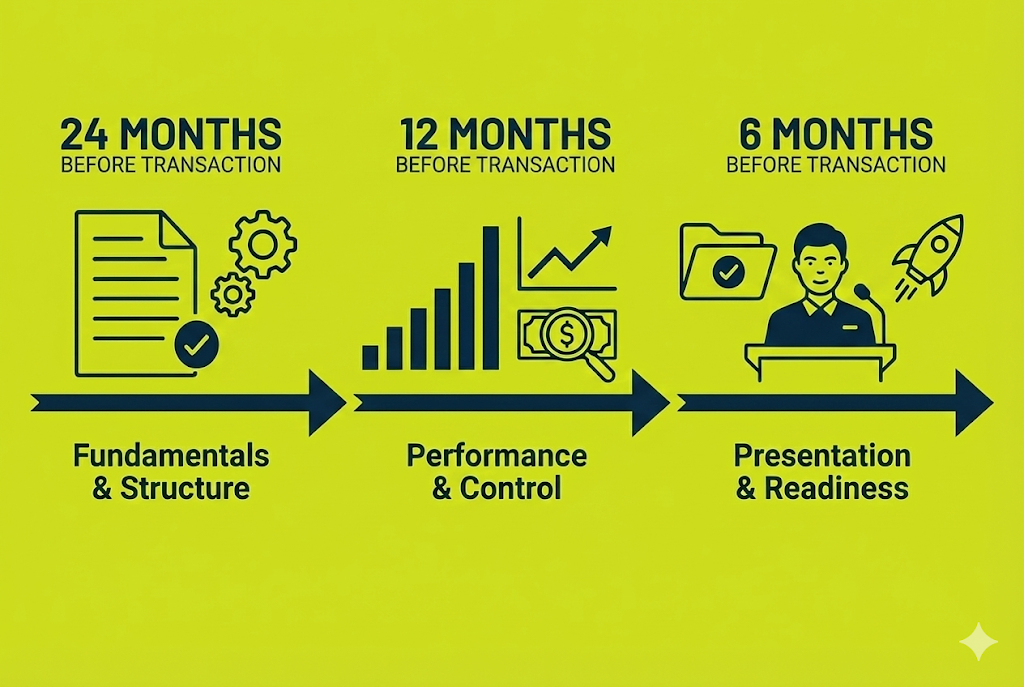
Exit readiness is not a single project, it is a sequence of disciplines that build on one another over time. The companies that achieve the smoothest transactions begin preparing long before they appoint advisors or engage with buyers. The first stage typically begins around twenty four months before a planned exit. At this point, the focus should be on strengthening the fundamentals: formalising accounting policies, defining KPIs, building clean datasets and establishing reliable reporting cycles. This is also the period to address structural issues such as cap table clarity, contract organisation and intellectual property assignments. Early preparation creates the foundation that later valuation will depend on.
Twelve months before a potential transaction, preparation shifts from structure to performance. Forecast accuracy becomes essential, working capital movements must be well understood and margins need to be stable and explainable. Many companies also choose to conduct an internal quality of earnings review at this stage. Doing so uncovers the issues a buyer would find and allows time to correct them. This period is also when leadership must demonstrate control. Investors want to see consistent performance and a narrative that shows how the past connects to the future.
The final six months are about presentation rather than construction. The data room should already be live and complete, the forecast should reflect current performance and financial statements should be audit ready. The focus turns to clarity: refining the equity story, ensuring documentation is accessible and preparing the team for buyer discussions. Companies that reach this stage in a state of readiness enter the market with confidence. They are not reacting to buyer questions, they are leading the conversation. When a business reaches this point, the exit process becomes smoother, faster and far more likely to achieve a premium outcome.
A successful exit is rarely the result of last minute preparation. It comes from years of building discipline into the business, strengthening its reporting, refining its metrics and creating an operation that can withstand scrutiny. This is where the fractional CFO becomes a powerful partner. With experience across multiple industries and transactions, a fractional CFO brings the structure, clarity and independence that most growing companies need. They help leadership see blind spots early, build credible forecasts, formalise financial processes and maintain the investor grade reporting that buyers expect. Above all, they ensure that when the opportunity to exit appears, the business is already prepared for the conversation.
In many cases, the greatest value a fractional CFO provides is confidence. Confidence for the founder, who knows the story is clear and the numbers are defensible. Confidence for internal teams, who rely on structured processes rather than reactive decision making. And confidence for buyers, who see a business that is transparent, consistent and well managed. When these strengths come together, the exit process shifts from uncertainty to opportunity. Instead of trying to convince buyers of potential, the business can demonstrate readiness, resilience and value.
Exit readiness is not only about selling a company. It is about building one that is strong enough to choose its own path. Whether the goal is a future acquisition, a funding round or long term stability, operating at investor grade elevates every part of the business. It brings clarity to leadership, discipline to operations and trust to every conversation. With the right financial foundation, an exit becomes not an aspiration, but a natural outcome of well managed performance.
If you are ready to prepare your business for a confident exit, we would love to help. Book a meeting with our team to explore how Quantro can build the investor grade reporting, forecasting and financial structure your company needs. Not just to complete a transaction, but to build clarity, control and confidence at every stage of the journey.
More from Quantro
Innovative cash flow management strategies are crucial for any business's survival and growth. In this blog, we cover optimising payment cycles, using financial tools for passive income, leveraging technology for real-time insights, and building a cash-savvy culture. The article provides practical advice, aiming to transform routine financial management into a strategic asset that enhances operational efficiency and financial stability, equipping businesses to navigate complex economic landscapes effectively.
Read More →Explore the complexities of scaling operations in service businesses. We look into recognising the right time to scale, addressing operational challenges, leveraging technology efficiently, maintaining exceptional customer experience, and managing team dynamics effectively. We use practical examples of how to use key performance indicators to navigate growth and ensure that your business not only expands in size but also enhances its capabilities and maintains its core values. Perfect for business leaders seeking to understand the nuances of sustainable growth in the service sector.
Read More →