
We are already well into 2026. Targets have been set. Budgets approved. Hiring plans discussed. For many businesses, the focus now is execution. Revenue growth remains the headline objective and momentum feels strong.
But in our work with scaling businesses at Quantro, we have seen that growth alone is never the full story. Without financial structure behind it, growth can stretch teams, dilute margins and create hidden pressure in operations. The question is no longer how fast can you grow. The more important question is how well your systems convert growth into operating profit.
As we move through 2026, five financial disciplines will separate businesses that scale sustainably from those that simply expand. These are not theoretical ideas. They are practical controls we implement with our clients to ensure that revenue momentum translates into profitable, controlled growth.
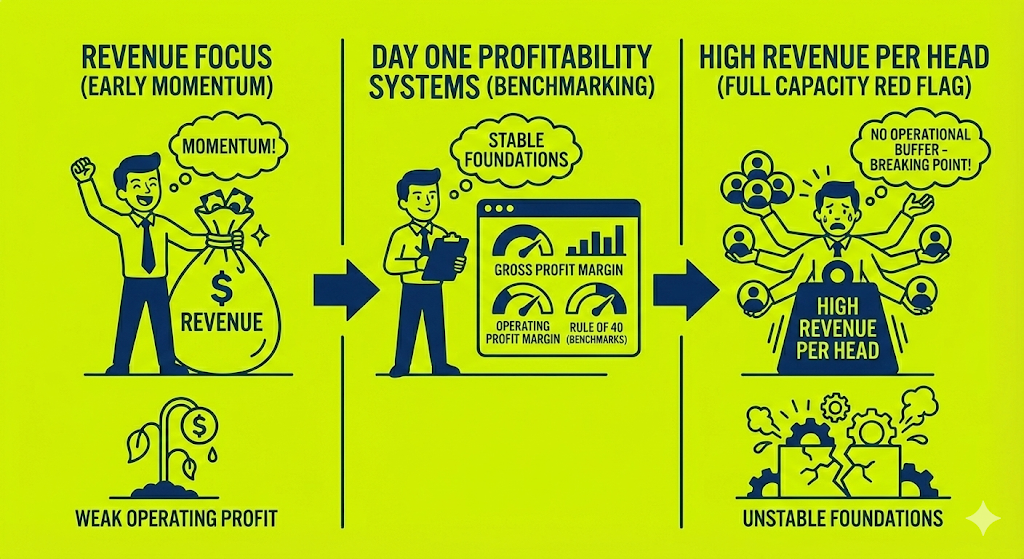
Most founders we work with at Quantro are client hungry. Revenue feels like oxygen. When the pipeline is full and new contracts are coming in, it creates momentum and confidence. And rightly so. Revenue is the engine of any business. But too often we see growth being celebrated without asking the harder question. Is this growth actually translating into operating profit?
From day one, we put systems in place to measure profitability properly. We track Gross Profit Margin, Operating Profit Margin and the Rule of 40. because these metrics tell us whether growth is structurally healthy. As a general benchmark, service businesses should aim for Gross Profit Margins above 50 percent, with many high performing firms operating closer to 60 or 70 percent. Operating margins will vary by stage, but a clear pathway towards double digit operating profit is essential. Mainly for SaaS, scaling businesses, the Rule of 40 provides an additional sense check. Your revenue growth rate plus your operating margin should exceed 40 percent. If revenue is growing but these metrics sit below benchmark, that is a red flag. Growth should strengthen margins, not quietly dilute them.
We also look closely at revenue per head. Many founders assume a high revenue per employee figure is a sign of efficiency. In reality, it can signal that the team is at full capacity. For many service businesses, revenue per head should sit within a sustainable band that allows operational buffer. If that figure climbs too aggressively without a corresponding increase in support or systems, it often means the company is stretched. The next new client does not create leverage. It creates stress. And that is usually when things start breaking.
One of the most common patterns we see across our clients is not a lack of ambition, but a lack of structure around hiring. Companies either overhire too early in anticipation of growth, or they underhire and stretch the team beyond capacity. Both decisions quietly damage margins. Both are expensive in different ways.
At Quantro, revenue per head is one of the most useful metrics we track. It tells us whether the business has spare capacity or no capacity at all. If revenue per head is too low, it may indicate overhiring. If it is too high, the company is operating at full stretch and the next contract will add pressure rather than profit. This is where many scaling businesses misread the signals. They see strong revenue and assume the system can absorb more. Often it cannot.
That is why we implement a decision tree roadmap during our annual budget sessions or at onboarding. We map hiring decisions to revenue unlocks in advance. When we hit a specific revenue milestone, we make a specific hire. It is built into our hypothesis model and our different budget scenarios. This removes emotional decision making and gives founders clarity. They can focus on building the business, knowing that hiring will follow structure rather than instinct.
One of our favourite books at Quantro is The Lean Startup by Eric Ries. The principle is simple. Build deliberately. Test assumptions. Eliminate waste. Yet when we begin working with a new client, one of the first things we discover is how quietly operating expenses have accumulated without scrutiny.
At onboarding, and then every three to six months, we conduct a detailed OPEX review. We examine fixed costs with a magnifying glass. The category that is most often overlooked is subscriptions and software tools. A founder signs up for a platform to test an idea, uses it a handful of times, and forgets about it. Nineteen ninety nine per month does not feel material. But multiply that across ten or fifteen tools and the leakage becomes significant.
In one case, we reduced subscription costs for a technology client by twenty five percent. That translated into roughly three thousand in annual savings without touching revenue. No restructuring. No layoffs. Just discipline. Lean is not about starving the business of resources. It is about protecting margin from unnecessary erosion so that every pound spent is intentional.
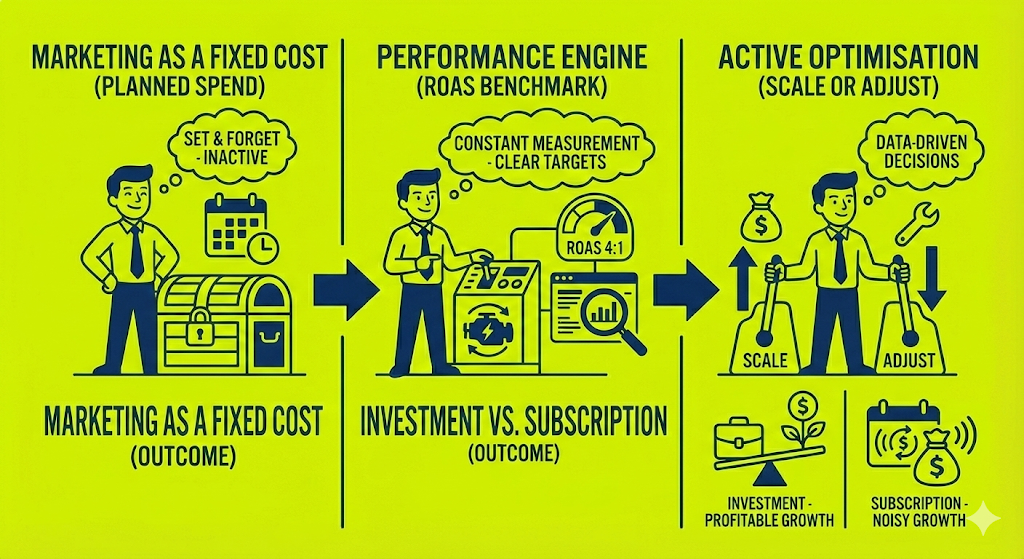
Most of our clients begin the year with a defined marketing budget. That is healthy. Planning spend in advance creates discipline and avoids reactive decisions. Where we often see problems arise is what happens afterwards. Marketing becomes treated as a fixed cost rather than an active investment that requires constant optimisation.
At Quantro, we work with a target ROAS of four to one. That benchmark forces clarity. It means that for every pound invested, we expect four back. We review advertising reports with our clients regularly and assess performance against this ratio. If the return is there, we scale. If it is not, we adjust. Marketing should not run on autopilot simply because it was approved in the annual budget.
The difference between cost and investment is measurement. When marketing is treated like an investment portfolio, it is reviewed, rebalanced and challenged. When it is treated like a subscription, it quietly consumes cash. In 2026, disciplined marketing spend will separate businesses that grow profitably from those that simply grow noisily.
The use of credit cards and factoring often comes down to the risk appetite of the founder. Some avoid them entirely. Others rely on them only when cash becomes tight. We take a more structured view. Credit tools should not be emergency solutions. They should be part of the financial architecture from early on.
Even if you do not need external financing, there is value in using a dedicated business credit card for recurring expenses such as subscriptions. By routing costs you already pay through a credit facility, you create a natural thirty day cash flow window. That alone improves liquidity. Added to that are cashback, points and other benefits that effectively reduce your net cost base. More importantly, a centralised credit tool improves spend visibility and approval control.
The same logic applies to factoring. Even if the business does not require it today, building a relationship early creates optionality. When growth accelerates or working capital tightens, the facility is already in place. Leverage is safest when it is arranged before it becomes necessary. In 2026, the businesses that think ahead about cash flow flexibility will operate with more confidence and control than those reacting under pressure.
Growth in 2026 will not be defined by how many new clients you sign. It will be defined by how well your financial structure absorbs that growth. Revenue without margin discipline creates stress. Hiring without triggers creates drag. Marketing without measurement consumes cash. And unmanaged spend quietly erodes profit.
At Quantro, we believe financial growth is built deliberately. We prioritise profitability from day one. We link hiring to revenue milestones. We review operating costs with discipline. We hold marketing to performance standards. And we use credit tools strategically to strengthen cash flow, not patch weaknesses.
The businesses that win in 2026 will not necessarily be the loudest or the fastest growing. They will be the most structured. Growth compounds when the system behind it is tight.
If you are building your 2026 plan and want to understand whether your revenue is truly converting into sustainable profit, this is the right time to review your numbers. At Quantro, we work closely with founders to implement the systems, benchmarks and financial discipline required for controlled, profitable scale. If you would like to assess your margins, hiring roadmap or cash flow structure, get in touch with us. Let us ensure that your next phase of growth is built to compound, not to crack under pressure.
More from Quantro
Innovative cash flow management strategies are crucial for any business's survival and growth. In this blog, we cover optimising payment cycles, using financial tools for passive income, leveraging technology for real-time insights, and building a cash-savvy culture. The article provides practical advice, aiming to transform routine financial management into a strategic asset that enhances operational efficiency and financial stability, equipping businesses to navigate complex economic landscapes effectively.
Read More →Explore the complexities of scaling operations in service businesses. We look into recognising the right time to scale, addressing operational challenges, leveraging technology efficiently, maintaining exceptional customer experience, and managing team dynamics effectively. We use practical examples of how to use key performance indicators to navigate growth and ensure that your business not only expands in size but also enhances its capabilities and maintains its core values. Perfect for business leaders seeking to understand the nuances of sustainable growth in the service sector.
Read More →