
In services businesses, growth is often framed as a simple equation. More clients means more revenue. On the surface, that logic holds. But underneath it sits a structural constraint that many founders overlook. Services businesses do not sell products. They sell time. And time is finite.
We see this most clearly with early-stage agencies and professional services firms that deliberately undersell their services to attract more clients. The revenue base may look strong, sometimes even impressive. But when we step back and look at operational metrics such as ARR per head and the personnel cost ratio, a different picture emerges. Teams are working at full capacity, often close to breaking point. Every additional client consumes time that the business does not actually have available.
This is where growth quietly stalls. When employees are fully utilised, the company has no room to onboard higher quality work, invest in improvement, or absorb volatility. The business becomes busy rather than scalable. In practice, more clients have not created growth. They have removed the very capacity required to grow.
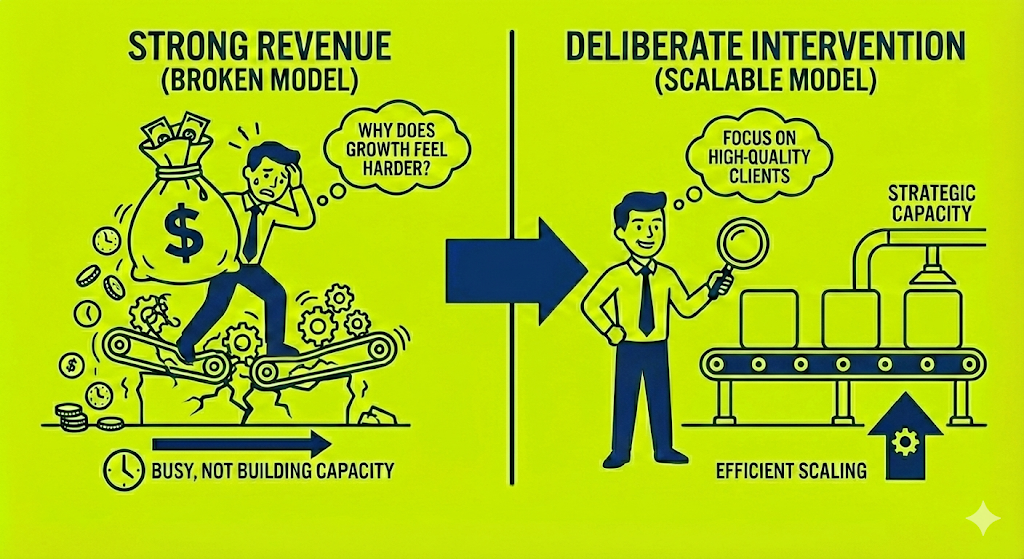
We usually start these conversations with a simple question: why does growth feel harder now than it did a year ago? The answer is rarely a lack of demand. In most cases, the business is already winning plenty of work. The real tension sits elsewhere. Every new client adds pressure rather than progress, and despite higher revenue, the company feels increasingly constrained.
This pattern shows up repeatedly in early-stage services businesses. By pricing aggressively to win more work, they create what looks like momentum. But once we analyse ARR per head and the personnel cost ratio, the issue becomes clear. Revenue is spread thin across too many low value engagements. Employees are working at full capacity, not because the business is scaling efficiently, but because it has sold too much time too cheaply.
At that point, opportunity cost becomes the silent killer. Every hour spent servicing low margin work is an hour that cannot be allocated to higher quality clients, better pricing, or strategic improvement. The business is busy, but it is not building the capacity required to move to the next stage. Without deliberate intervention, growth becomes self limiting.
One of the first changes we introduce with clients at Quantro is time tracking. Not as a control mechanism, and not to monitor individuals, but to understand how the business actually makes money. Until time is measured, most services companies are guessing. They know their revenue, but they do not know their unit economics.
Once time tracking is in place, patterns emerge quickly. We can see where teams spend disproportionate amounts of time and which clients generate revenue with relatively little effort. In almost every case, there is a clear gap between perceived profitability and actual profitability. Some clients that feel valuable are quietly loss making. Others produce what we often call easy money.
This clarity changes decision making. Instead of debating clients emotionally or relying on gut feel, founders can compare revenue per hour worked across the client base. From there, choices become deliberate. We either upsell clients who create strong value density or we stop serving those where the economics consistently do not work. The objective is not to reduce client numbers for the sake of it, but to protect and rebuild profitable capacity.
Almost every founder tells us they want fewer and better clients. In practice, that ambition is often followed by hesitation. The fear is understandable. Letting go of clients feels like introducing risk, especially when revenue has taken real effort to build. For many businesses, the issue is not that they have too many clients, but that they are uncertain about which ones they can afford to lose.
This is where the conversation shifts from volume to balance. At Quantro, we look closely at client concentration alongside unit economics. A business with only a handful of large contracts may appear efficient, but it can also be fragile. If one client represents a disproportionate share of revenue, a single decision outside the company’s control can destabilise the entire operation.
Exploring profitable capacity therefore requires trade-offs. Some companies do need fewer clients. Others need better pricing, clearer scope, or improved allocation of time. By benchmarking top client contracts and ensuring that no single client exceeds around ten to twenty percent of total revenue, depending on context, founders can reduce risk while still making room for more valuable work. The goal is not minimalism. It is resilience.
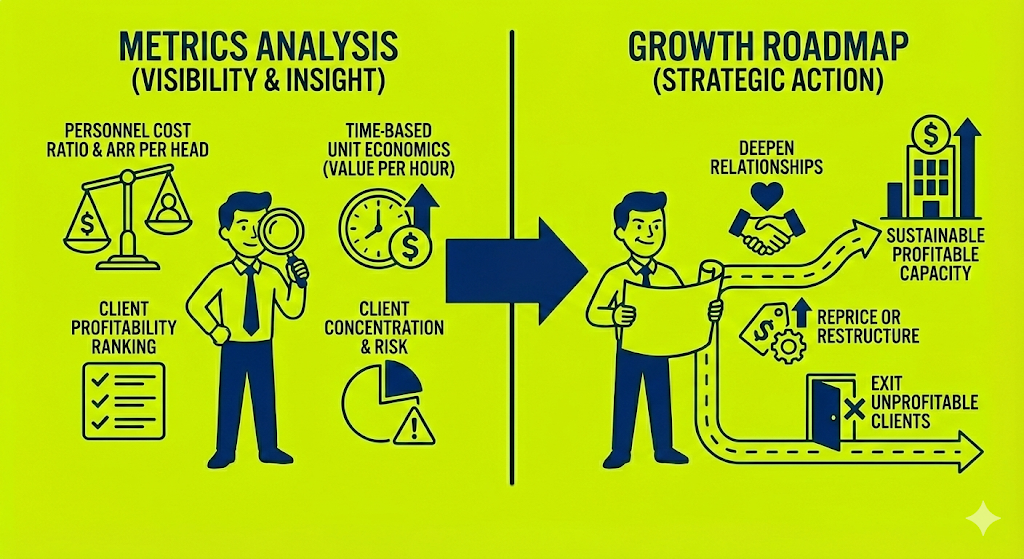
Once the numbers are visible, the path forward tends to clarify itself. We start by looking at the personnel cost ratio and ARR per head to understand whether the team is already operating at full capacity or whether there is room to grow without additional strain. This immediately reframes the growth conversation. Instead of asking how to win more clients, the question becomes how to use existing capacity more deliberately.
From there, time-based unit economics allow us to rank clients by the value they generate per hour worked. This reveals where the business is being rewarded for its expertise and where it is quietly subsidising clients through underpriced work. Combined with client concentration analysis, we can assess not only profitability but also risk exposure. A highly profitable client is not an asset if losing them would destabilise the company.
Together, these metrics form a practical roadmap. They inform which clients to deepen relationships with, which to reprice or restructure, and which to exit entirely. In many cases, the outcome is fewer clients. In others, it is the same number of clients producing significantly more profit. Either way, the objective remains the same. Sustainable growth comes from building profitable capacity first, not from chasing volume.
When founders reframe growth around capacity rather than volume, behaviour changes quickly. Pricing conversations become more confident. Scope becomes clearer. Teams regain breathing room. Growth decisions are no longer driven by anxiety about the next client, but by an understanding of what the business can absorb without breaking.
This is also where many services businesses realise that their constraints were not market driven. Demand was never the issue. The limitation sat inside the operating model. By selling time too cheaply and spreading it across too many low value engagements, they created their own ceiling. Profitable capacity removes that ceiling by forcing the business to allocate people, time and risk intentionally.
More clients can still be part of the picture. But they are no longer the objective. When capacity is profitable and risk is controlled, growth becomes a choice rather than a necessity. That is when a services business stops reacting and starts compounding.
If growth feels constrained despite strong revenue, the issue is rarely demand. It is usually capacity, pricing, or risk hiding beneath the surface. The fastest way to regain clarity is to stop looking at revenue in isolation and start understanding how time, people and clients actually interact.
At Quantro, we help services businesses analyse profitable capacity through unit economics, client concentration and balance-sheet risk. The outcome is not a generic growth plan, but a clear view of where to focus, what to change, and what to stop doing.
If you want to understand whether your current client mix is supporting sustainable growth or quietly limiting it, start with the numbers. They tend to be far more honest than intuition.
More from Quantro
Innovative cash flow management strategies are crucial for any business's survival and growth. In this blog, we cover optimising payment cycles, using financial tools for passive income, leveraging technology for real-time insights, and building a cash-savvy culture. The article provides practical advice, aiming to transform routine financial management into a strategic asset that enhances operational efficiency and financial stability, equipping businesses to navigate complex economic landscapes effectively.
Read More →Explore the complexities of scaling operations in service businesses. We look into recognising the right time to scale, addressing operational challenges, leveraging technology efficiently, maintaining exceptional customer experience, and managing team dynamics effectively. We use practical examples of how to use key performance indicators to navigate growth and ensure that your business not only expands in size but also enhances its capabilities and maintains its core values. Perfect for business leaders seeking to understand the nuances of sustainable growth in the service sector.
Read More →