
When Revenue Is Strong but Profit Is Unclear
A digital services agency came knocking the door to us for help. Their work is high quality, their clients value them, and projects continue to come through the door. From a delivery perspective, the business was doing many things right. The challenge was that this excellence was not translating into strong and predictable financial results.
As the agency grew, the team found themselves constantly reacting to incoming work. There was no clear system to anticipate projects, understand how each engagement performed financially, or see which work was truly contributing to gross margin and operating profit. Too many hours were being spent on projects that were underpriced, and profitability became increasingly difficult to predict, even during busy periods.
By bringing Quantro in, the goal was not to change what the founders loved doing. It was to build a system around it. In the sections that follow, we look at how introducing clarity around project economics, cost structure, and planning allowed the agency to continue delivering great work while materially improving gross margin and operating profit.
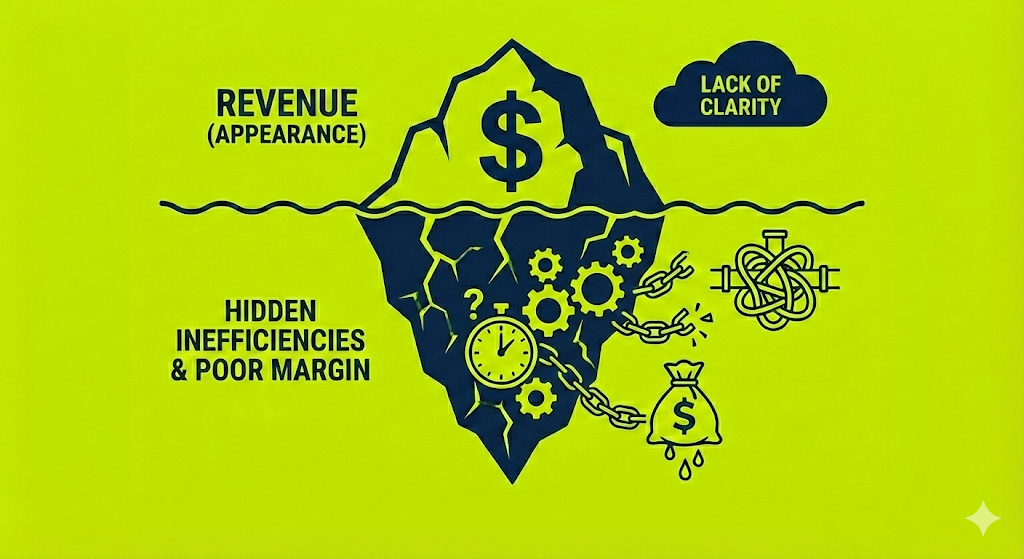
Before Quantro stepped in, the business did not struggle to win work. The founders were strong operators and their reputation meant projects continued to come through the door. The difficulty was that there was no reliable way to anticipate what was coming next. Without a clear view of the pipeline and upcoming delivery demands, the team was constantly reacting to new projects rather than planning for them.
This lack of predictability placed pressure on delivery. Projects were often accommodated at short notice, stretching the team and increasing the number of hours spent on each engagement. Over time, this meant that work which appeared profitable at the proposal stage became unprofitable in practice. Gross margin suffered not because prices were always wrong, but because delivery was not anchored to a clear understanding of time, cost, and capacity.
What we see repeatedly in service businesses is that growth without structure creates hidden inefficiencies. Revenue can mask underlying issues for a long time. In this case, the absence of systems and clarity meant the founders were working hard, but without the financial insight needed to protect and improve gross margin.
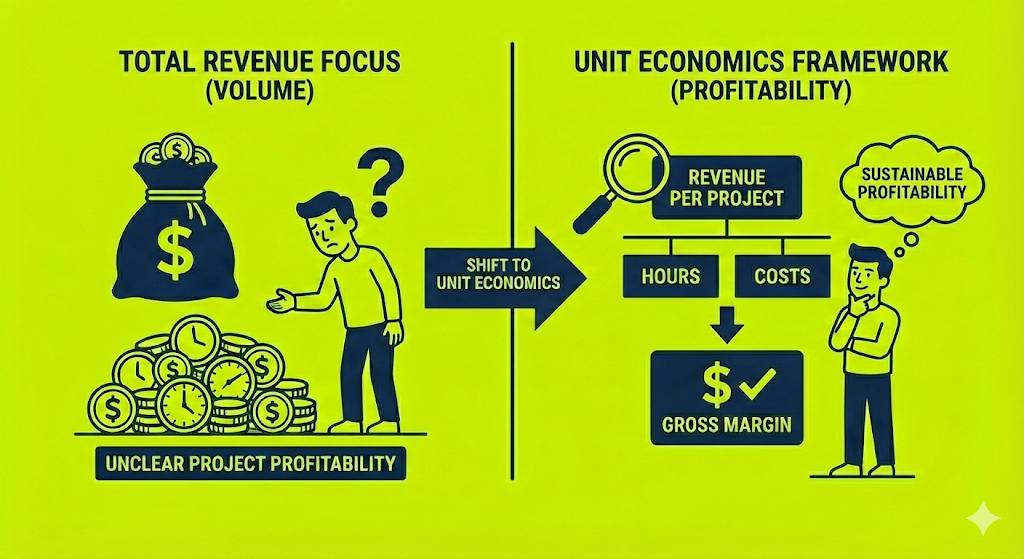
At Quantro, we work with service businesses every day, and the reality is simple. Services businesses sell time. Whether it is packaged projects or ongoing retainers, revenue is ultimately driven by hours delivered. Without understanding the unit economics at a project level, it is impossible to know how profitable the business truly is.
We introduced a unit economics framework that allowed the founders to see each project through a financial lens. By mapping revenue against the actual hours and costs required to deliver the work, it became clear which projects were contributing positively to gross margin and which were not. This clarity shifted conversations away from total revenue and towards sustainable profitability.
Once this visibility was in place, decision making improved quickly. The team could identify which types of projects to prioritise, which clients had room for upselling, and which engagements no longer made sense at their current pricing. Instead of chasing volume, the focus moved to doubling down on work that consistently generated healthy gross margins.
For many startups and growing service businesses, the early focus is understandably on winning clients. In the rush to build momentum, it is common to agree to pricing or project structures that are not sustainable in the long term. This business was no different. Several projects looked attractive from a revenue perspective, but once delivery costs were fully understood, they were clearly underpriced.
By applying a unit economics lens, these issues became visible. Rather than relying on instinct, the founders could see in black and white which projects were eroding gross margin. In many cases, the solution was not to walk away immediately, but to identify opportunities for upselling or restructuring the scope of work so that pricing better reflected the value delivered.
These changes required difficult conversations with clients. Not every founder finds this easy, especially when relationships are still relatively new. Our role at Quantro was to support these discussions with data and clarity, giving the founders the confidence to reset expectations and protect the long term health of the business.
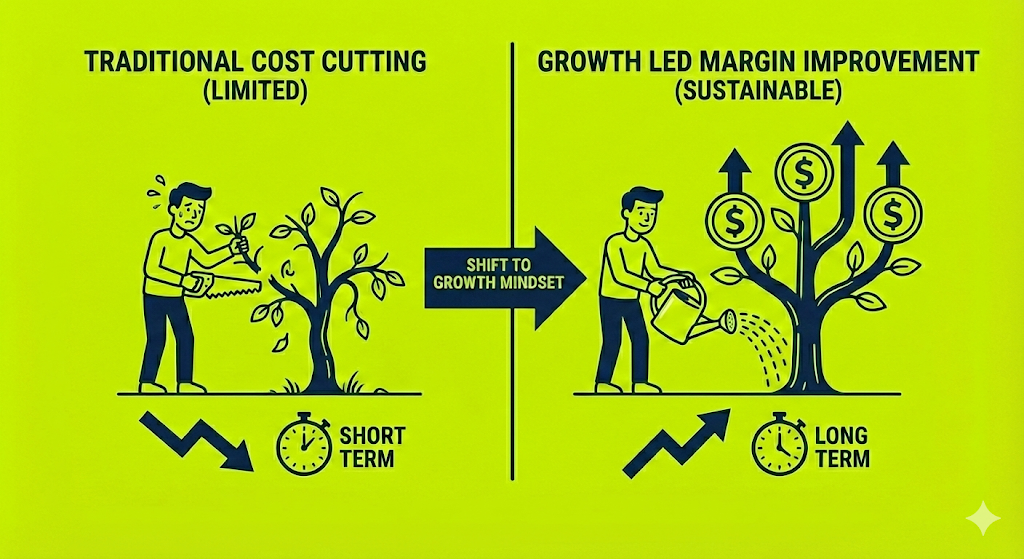
When businesses start to focus on profitability, the instinct is often to look for costs to cut. While this can create short term improvements, it quickly reaches a limit. At Quantro, we approach margin improvement with a growth mindset. The real leverage, especially in service businesses, comes from improving how revenue is generated rather than only reducing spend.
With the founders, we started by understanding their long term goals and what success looked like for the business. From there, we built a budget with three clear scenarios, each reflecting a different growth outcome. This allowed us to move away from abstract targets and towards a concrete plan that linked revenue, capacity, and gross margin together.
By reverse engineering these scenarios, the founders could see exactly what level of revenue was required to achieve their desired outcomes and how this would translate into additional profit in pounds. This process turned financial planning into a practical decision making tool, rather than a theoretical exercise.
One of the most common issues we encounter with founders is confusion around cost classification. When it is unclear which costs sit within cost of sales and which belong in operating expenses, gross margin becomes distorted. This often leads founders to believe their projects are more profitable than they actually are, or in some cases, less profitable than reality.
In this business, correcting cost classification was a critical step. By clearly separating delivery related costs from overheads, we were able to present a more accurate picture of gross profit at both a project and business level. This clarity made earlier decisions around pricing and project selection far more reliable.
At Quantro, we do not see this as a reporting exercise. We work hands on with clients, acting as an extension of their internal team. Our goal is to ensure founders understand why costs are classified the way they are and how this impacts gross margin. That understanding is what allows better decisions to be made long after our initial work is complete.
By introducing clarity around unit economics, delivery costs, and cost classification, the business moved from reacting to projects to actively shaping its profitability. Gross margin improved, not through aggressive cost cutting, but by focusing on the right work, pricing it appropriately, and planning growth with intention. Most importantly, profit became predictable, giving the founders confidence in both short term decisions and long term strategy.
The additional margin translated directly into more money hitting the bottom line in pounds, but the real shift was cultural. Financial insight became part of everyday decision making, rather than something reviewed after the fact. With better visibility, the team could forecast more accurately, manage capacity more effectively, and scale without sacrificing profitability.
If you are running a service business and recognise this tension between revenue growth and unpredictable profit, Quantro can help. We work alongside founders to build clarity into their numbers, improve gross margin, and turn financial insight into a practical tool for growth. If you would like to explore how this could work for your business, get in touch and start the conversation.
More from Quantro
Innovative cash flow management strategies are crucial for any business's survival and growth. In this blog, we cover optimising payment cycles, using financial tools for passive income, leveraging technology for real-time insights, and building a cash-savvy culture. The article provides practical advice, aiming to transform routine financial management into a strategic asset that enhances operational efficiency and financial stability, equipping businesses to navigate complex economic landscapes effectively.
Read More →Explore the complexities of scaling operations in service businesses. We look into recognising the right time to scale, addressing operational challenges, leveraging technology efficiently, maintaining exceptional customer experience, and managing team dynamics effectively. We use practical examples of how to use key performance indicators to navigate growth and ensure that your business not only expands in size but also enhances its capabilities and maintains its core values. Perfect for business leaders seeking to understand the nuances of sustainable growth in the service sector.
Read More →