
Most founders speak about exit as if it is a future milestone. Something that will be addressed once revenue is higher, the team is larger and the timing feels right. In reality, the businesses that exit well are built with that outcome in mind from much earlier on. Exit readiness is not a transaction. It is a way of operating.
Being ready to sell does not mean you are planning to sell tomorrow. It means your financials, reporting and operations are structured so that you could withstand scrutiny at any point. The founder who builds with this mindset creates optionality. The founder who delays it often finds themselves reacting under pressure.
At Quantro, we see exit readiness as a continuous process. That means live P&L reporting, real time accounting data and financial visibility that is accessible whenever it is needed. Not when a buyer requests it, but as a standard way of running the business.
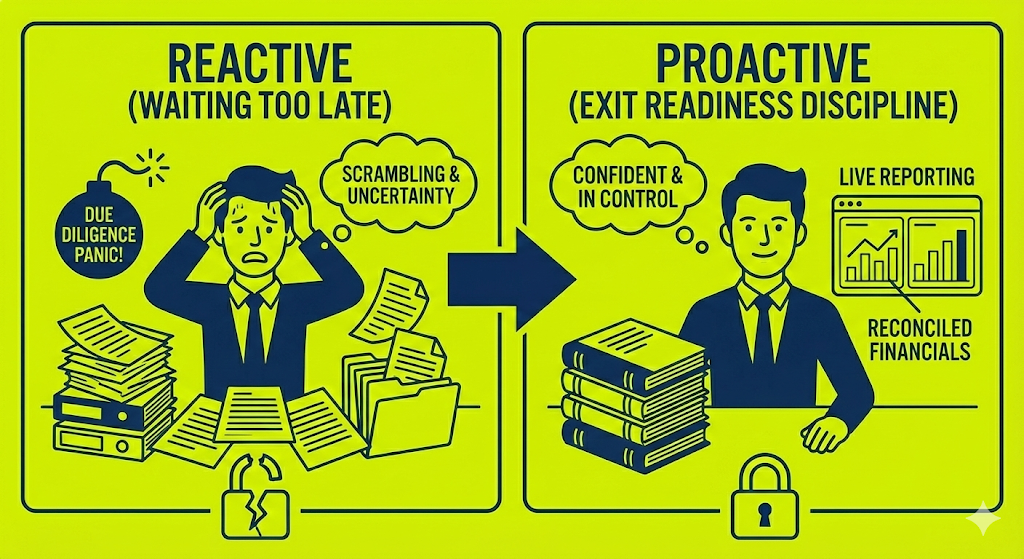
The biggest mistake founders make is waiting until a deal is already in motion before getting their financial house in order. Once due diligence begins, everything becomes urgent. Historic decisions need to be justified. Numbers that once felt sufficient are suddenly questioned. What should be a position of strength quickly turns into a period of stress.
Exit readiness is not something you switch on when an offer appears. It is a discipline that runs alongside growth. If your financials are not structured, reconciled and consistently reported, you are not just creating operational friction. You are weakening your credibility at the exact moment it matters most. Buyers do not only assess performance. They assess control.
The businesses that navigate exits smoothly are those that treat financial visibility as a constant. Live reporting, up to date P&L statements and accessible accounting information remove uncertainty from the process. Instead of scrambling to explain the past, founders are able to confidently articulate it.
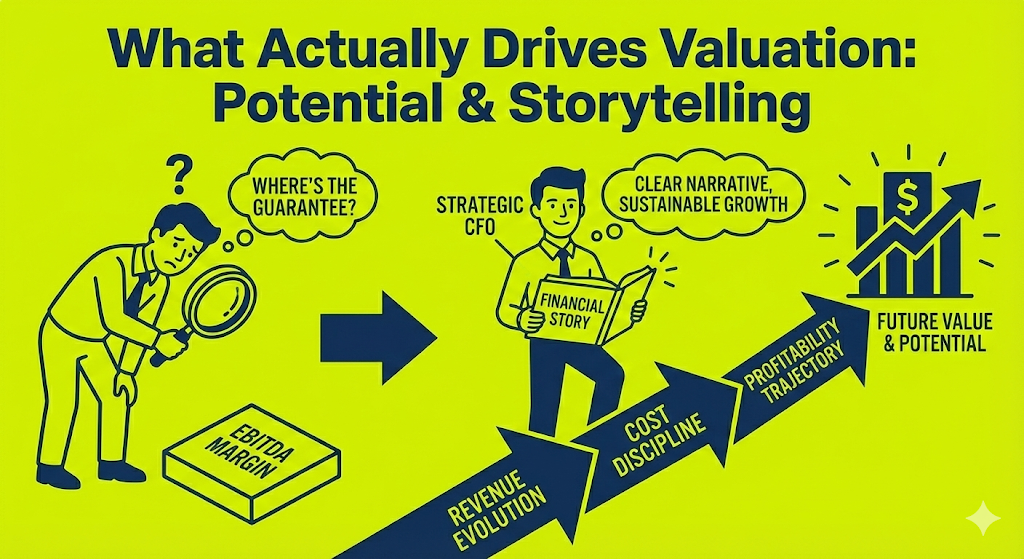
Founders often search for the metric that will unlock a higher multiple. They ask whether it is EBITDA margin, recurring revenue percentage or growth rate that matters most. The reality is far less mechanical. There is no single number that guarantees a strong exit.
What moves the valuation needle is potential. Buyers want to see progression. They look at how revenue, costs and EBITDA have evolved over time and whether that trajectory signals sustainable growth. A flat story with one impressive metric rarely convinces anyone. A clear upward journey with disciplined cost control and improving profitability does.
This is where financial storytelling becomes critical. Numbers alone do not build conviction. The role of a strategic CFO is to look at the figures and explain what happened, why it happened and what it means for the future. That clarity cannot be replicated by basic bookkeeping or automated dashboards. It requires judgement, context and the ability to translate performance into a forward looking narrative.
There is no secret that due diligence is often the most stressful phase of an exit. Buyers begin to examine decisions made years earlier. Assumptions are challenged. Small inconsistencies that once felt insignificant can suddenly become points of concern. For many smaller, unaudited businesses, this level of scrutiny is unfamiliar and uncomfortable.
Deals rarely collapse because the company is fundamentally weak. They collapse because explanations are unclear. If revenue recognition is inconsistent, if cost allocations cannot be justified, or if historic fluctuations cannot be articulated, confidence erodes quickly. And once confidence goes, valuation follows.
The way to reduce this risk is to operate as if you are under light due diligence throughout the year. Reviewing numbers rigorously, pressure testing assumptions and ensuring that every material movement can be explained creates financial integrity. When scrutiny eventually comes, the founder is not defending the past. They are confidently walking through it.
The simple answer is earlier than most founders think. If exit is even a distant ambition, the financial structure should reflect that from the beginning. Waiting until revenue reaches a certain threshold or complexity becomes uncomfortable often means valuable time has already been lost.
An exit friendly business is not defined by size. It is defined by discipline. Some early stage startups may only require a few hours of strategic financial oversight each month to ensure that reporting, forecasting and controls are built correctly from the start. Larger multi million revenue businesses may require deeper involvement. The principle is the same. The structure scales with the business.
A fractional model removes the traditional barrier to senior financial leadership. It allows founders to embed financial rigour without committing to a full time hire before the business truly needs it. More importantly, it ensures that when opportunity arises, the company is structurally prepared rather than strategically surprised.
The strongest exits rarely begin with a sudden decision to sell. They are the result of years of disciplined financial thinking. When a business is built with clarity, control and consistency, the founder is not forced into a transaction. They are able to choose one.
Exit readiness creates leverage. It reduces stress during due diligence, strengthens negotiating power and increases the likelihood that buyers focus on potential rather than problems. More importantly, it allows founders to run better businesses today. Clear reporting, structured forecasting and a coherent financial narrative do not only serve an eventual buyer. They serve growth, hiring and strategic decision making along the way.
If you are building with the ambition to create long term value, the question is simple. Could your business withstand full due diligence tomorrow. If the answer is uncertain, it may be time to approach your financial strategy differently. At Quantro, we help founders design businesses that are ready when opportunity appears, not scrambling when it does. If you want to explore what exit readiness would look like for your company, let’s start that conversation now.
More from Quantro
Innovative cash flow management strategies are crucial for any business's survival and growth. In this blog, we cover optimising payment cycles, using financial tools for passive income, leveraging technology for real-time insights, and building a cash-savvy culture. The article provides practical advice, aiming to transform routine financial management into a strategic asset that enhances operational efficiency and financial stability, equipping businesses to navigate complex economic landscapes effectively.
Read More →Explore the complexities of scaling operations in service businesses. We look into recognising the right time to scale, addressing operational challenges, leveraging technology efficiently, maintaining exceptional customer experience, and managing team dynamics effectively. We use practical examples of how to use key performance indicators to navigate growth and ensure that your business not only expands in size but also enhances its capabilities and maintains its core values. Perfect for business leaders seeking to understand the nuances of sustainable growth in the service sector.
Read More →