
Why “AI-First” Finance Is Being Misunderstood
AI has quickly become one of the most talked about forces in finance. Every week there is a new tool, a new promise, or a new headline suggesting that analysts, controllers and even CFOs will soon be replaced by machines. In many organisations, this has created pressure to move fast and declare themselves “AI-first” without fully understanding what that actually means. AI is treated as a shortcut to efficiency rather than a fundamental shift in how finance should operate and think.
The reality is more nuanced. An AI-first finance function is not one where humans step aside and let technology take over. It is one where finance leaders use AI to create faster results, sharpen judgement, improve visibility and support better decisions. When AI is introduced without strong financial understanding behind it, it does not create clarity. It creates noise. The goal for 2026 is not to remove people from finance, but to redesign the function so that technology does the heavy lifting and humans focus on insight, context and accountability. Used well, AI strengthens finance. Used poorly, it simply accelerates existing problems.
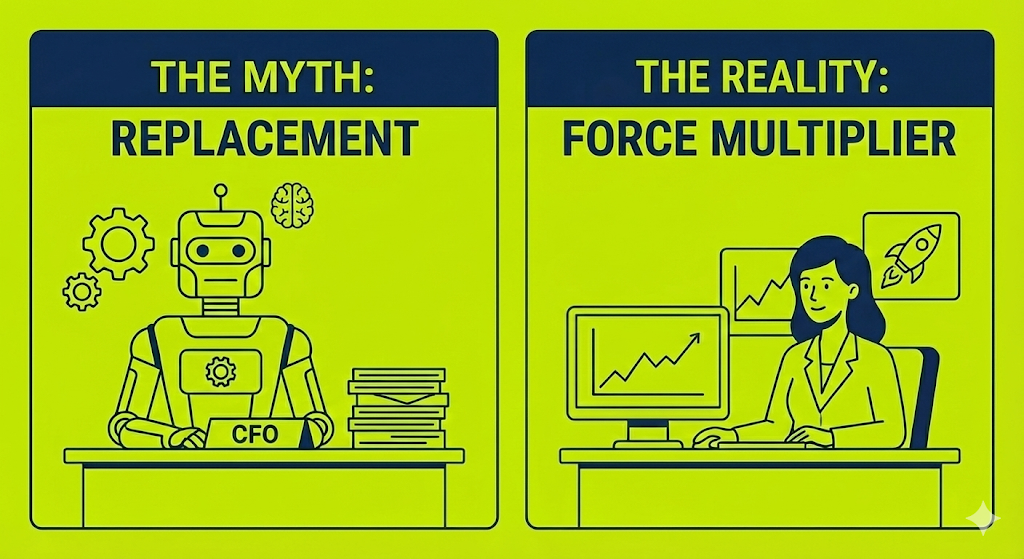
One of the most persistent myths around AI-first finance is the idea that technology can simply replace finance analysts, managers or CFOs. This assumption usually comes from viewing finance as a production line of reports and calculations, rather than as a discipline built on judgement, context and interpretation. AI is exceptionally good at processing information at speed, but it does not understand a business in the way an experienced finance professional does. Without that understanding, even the most advanced tools can produce outputs that look convincing while being fundamentally wrong.
In practice, AI works best as a force multiplier for strong finance teams. It allows skilled professionals to move faster, test scenarios more easily and focus their attention on the areas that truly matter. However, this only works when the people using the tools are able to spot errors, challenge assumptions and guide the system in the right direction. Prompting, sense checking and interpretation become critical skills. The risk is not that AI will replace finance professionals, but that organisations deploy it without the expertise required to control it. In those situations, AI does not eliminate risk. It amplifies it.
This is why the future of finance depends less on the tools themselves and more on the people behind them. AI in the hands of a capable finance leader can unlock significant value. In the absence of that leadership, it becomes a black box that produces answers without accountability. An AI-first finance function, therefore, is not about removing humans from the process. It is about elevating their role from producing numbers to owning the decisions those numbers inform.
Many businesses expect automation and AI to deliver immediate improvements. In reality, the early stages often feel like a step backwards. When manual spreadsheets are replaced with automated reporting or BI dashboards, long standing issues that were previously hidden tend to surface all at once. Inconsistent data definitions, manual workarounds and gaps in source systems become visible. What looked like a smooth process on the surface is suddenly exposed as fragile underneath.
This is where frustration usually sets in. Leadership questions the value of the investment and teams lose confidence in the outputs. The issue, however, is rarely the technology itself. Automation does not create bad data, it reveals it. When unreliable inputs are fed into automated systems, the result is faster and more visible errors. This is the practical meaning of “garbage in, garbage out” and it is a stage that many finance teams must work through before seeing real benefits.
The organisations that succeed are the ones that recognise this phase as part of the journey rather than a failure. They slow down, revisit assumptions and fix problems at the source. Over time, as data quality improves and processes stabilise, automation begins to deliver on its promise. Reporting becomes more consistent, insight improves and trust gradually returns. The key lesson is simple. AI and automation reward discipline. Without it, they make weaknesses impossible to ignore.
Example: A client of ours was promised automated bookkeeping from a well known ERP software company. What it got is a tool full of bugs and twice the time needed to do the same job by simply using the existing “old fashion” accounting software. AI can definitely help post transactions at a faster pace, but the human eye should always be there to review and confirm at the end.
As AI takes on more of the operational work in finance, a natural question emerges. What should still be done by people? The temptation is to push automation as far as possible, including areas that require judgement and interpretation. This is where many AI-first initiatives begin to lose their way. While AI can analyse patterns and surface trends, it struggles to provide meaningful strategic commentary. It does not understand founder psychology, industry nuance or how much risk a leadership team is truly willing to take.
Strategic insight is not produced by numbers alone. It comes from experience, relationships and a deep understanding of the business context. A finance professional can sense when a plan feels overly optimistic, when a market assumption no longer holds or when the timing of a decision matters more than the numbers suggest. These are not skills that can be automated. In fact, trying to automate them often strips finance of its most valuable contribution to leadership.
The most effective AI-first finance functions draw a clear line. AI handles the preparation, consolidation and analysis of data. Humans own the interpretation, narrative and recommendations. This balance ensures that technology enhances decision making rather than replacing it with generic insight. By keeping strategic commentary human led, finance remains a trusted partner to the business, not just a producer of automated outputs.
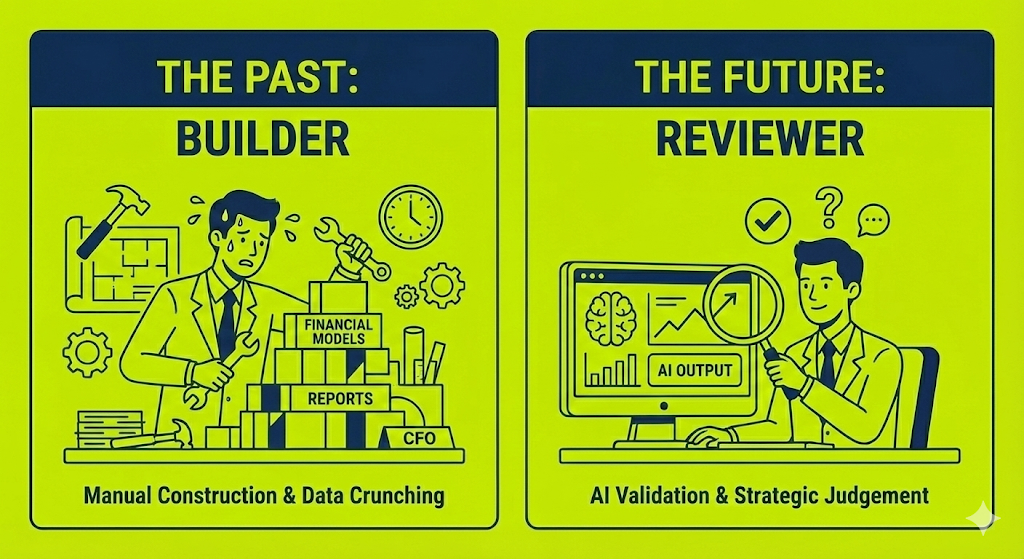
As AI becomes embedded in finance processes, the role of the CFO begins to shift in subtle but important ways. Traditionally, a significant amount of time has been spent building models, preparing reports and refining forecasts. AI changes this dynamic. Much of the construction work can now be done faster and more efficiently by technology, freeing finance leaders to focus on what really matters. The value no longer sits in creating the output, but in validating it.
This does not mean the CFO becomes less involved. If anything, responsibility increases. Reviewing AI generated outputs requires a sharp eye, strong judgement and a deep understanding of the business. Finance leaders must be able to sense check results, challenge assumptions and identify when something does not align with reality. AI can suggest outcomes, but it cannot take responsibility for decisions. That accountability still sits firmly with humans.
In an AI-first finance function, the CFO acts as the final filter between automated analysis and real world action. This role demands confidence, curiosity and the willingness to question even the most polished outputs. By shifting from builder to reviewer, finance leaders protect the integrity of decision making while benefiting from the speed and scale that AI provides.
Much of the conversation around AI in finance focuses on dashboards, insights and advanced analytics. Yet the real foundation sits much lower in the stack. If the underlying data is inconsistent, incomplete or manually manipulated, no amount of AI will produce reliable outcomes. Many organisations invest heavily in how they want to visualise their data, while overlooking how that data is captured in the first place. This imbalance quietly undermines every AI initiative that follows.
Bookkeeping and data organisation will become one of the most important battlegrounds in finance by 2026. When transactions are recorded manually across spreadsheets, multiple ERPs or legacy systems, AI has nothing solid to work with. Automated tools can only categorise, analyse and predict based on what they are given. A unified data architecture, where information flows cleanly from source systems into finance, is not a nice to have. It is a prerequisite for AI-first operations.
The biggest gains often come from unglamorous improvements. Connecting bank feeds directly, automating transaction categorisation and enforcing consistent data structures can remove a vast amount of manual effort. In many cases, getting this right delivers the majority of the value before any advanced analytics are introduced. When data enters the system cleanly and consistently, AI becomes genuinely useful. Without that foundation, even the most sophisticated agents remain ineffective.

Building an AI-first finance function is not about moving as fast as possible. It is about moving in the right order. The first priority should be establishing strong foundations. This means cleaning up data, standardising bookkeeping and reducing reliance on manual spreadsheets. When data flows consistently from source systems, finance teams can trust the numbers they are working with and begin to automate with confidence.
Once the foundations are in place, automation can be applied to core finance processes such as consolidation, reporting and management information. At this stage, AI begins to free up time rather than create confusion. Forecasting, scenario planning and cash flow analysis become more dynamic, supported by models that update as new information comes in. The focus shifts from producing reports to understanding what they are saying.
By 2026, the most advanced finance functions will use AI to support continuous insight and decision making. Teams will spend less time preparing data and more time reviewing, challenging and advising. The organisations that succeed will not be those that adopted the most tools, but those that sequenced their transformation thoughtfully. AI rewards patience, discipline and clarity of purpose.
AI will not make finance obsolete, but it will make weak foundations impossible to hide. As technology accelerates the speed at which information is processed, the quality of decisions will depend more than ever on the people and structures behind the numbers. An AI-first finance function is not defined by the tools it uses, but by the judgement, discipline and accountability embedded in the way it operates.
The organisations that will thrive by 2026 are those that invest early in clean data, strong processes and capable finance leadership. They understand that AI is not a shortcut to insight, but a lever that amplifies what already exists. When finance teams combine technology with human understanding, they move beyond reporting and become true partners in decision making. AI does not replace finance thinking. It demands better finance thinking than ever before.
More from Quantro
Innovative cash flow management strategies are crucial for any business's survival and growth. In this blog, we cover optimising payment cycles, using financial tools for passive income, leveraging technology for real-time insights, and building a cash-savvy culture. The article provides practical advice, aiming to transform routine financial management into a strategic asset that enhances operational efficiency and financial stability, equipping businesses to navigate complex economic landscapes effectively.
Read More →Explore the complexities of scaling operations in service businesses. We look into recognising the right time to scale, addressing operational challenges, leveraging technology efficiently, maintaining exceptional customer experience, and managing team dynamics effectively. We use practical examples of how to use key performance indicators to navigate growth and ensure that your business not only expands in size but also enhances its capabilities and maintains its core values. Perfect for business leaders seeking to understand the nuances of sustainable growth in the service sector.
Read More →